
Edinburgh for Writers: Beyond the Tourist Trail
A research guide to Edinburgh for writers. Beyond the Royal Mile and castle views—how to find the city's literary layers, hidden archives, and neighborhoods that reward slow attention."

Edinburgh is a city that looks like it was designed for writers. The medieval Old Town stacked on volcanic rock. The Georgian New Town laid out in rational grids. Closes and wynds that dead-end unexpectedly. Weather that shifts three times before lunch.
It's photogenic, yes. But for writers, the danger is stopping at the surface—collecting images without understanding how the city actually works.
This guide is for writers who want to go deeper. Not a list of literary landmarks, but an approach to Edinburgh as a place that rewards research.
Two Cities in One
Edinburgh's defining feature isn't its castle or its festivals. It's the split.
The Old Town is vertical, chaotic, layered. Buildings lean. Streets change names mid-block. The logic is medieval—growth by accumulation rather than plan.
The New Town is horizontal, orderly, enlightened. Streets run in straight lines. Addresses make sense. The logic is 18th-century rationalism made visible.
Understanding this split matters for writers because it shapes everything: how characters would move through space, what they'd see, how class and history remain physically present in the landscape.
Walk both. Notice how your pace changes. Notice what each allows and what each conceals.
Where to Base Yourself
Old Town — Best for: historical fiction, crime fiction, stories about hidden lives and vertical space
Stay in the Old Town if your work requires atmosphere, if you need to understand how people navigated tight spaces and limited light. The Royal Mile is touristy, but the closes off it are not. Grassmarket has more texture than the streets above it.
Stockbridge — Best for: contemporary fiction, character studies, understanding Edinburgh's village-within-a-city quality
A fifteen-minute walk from the center, Stockbridge feels like a separate town. Sunday markets, independent shops, the Water of Leith running through. Good for writers who need residential rhythm rather than tourist density.
Leith — Best for: working-class narratives, port city history, contemporary grit
Edinburgh's port, historically separate and still distinct. Gentrifying but not yet homogenized. Useful for writers whose Edinburgh isn't the one on postcards.
New Town — Best for: Georgian-era research, architecture as character, stories about respectability and restraint
The grid makes navigation easy. The architecture is uniform in a way that reveals its own kind of character. Good for understanding how space was designed to communicate status.
Research Resources
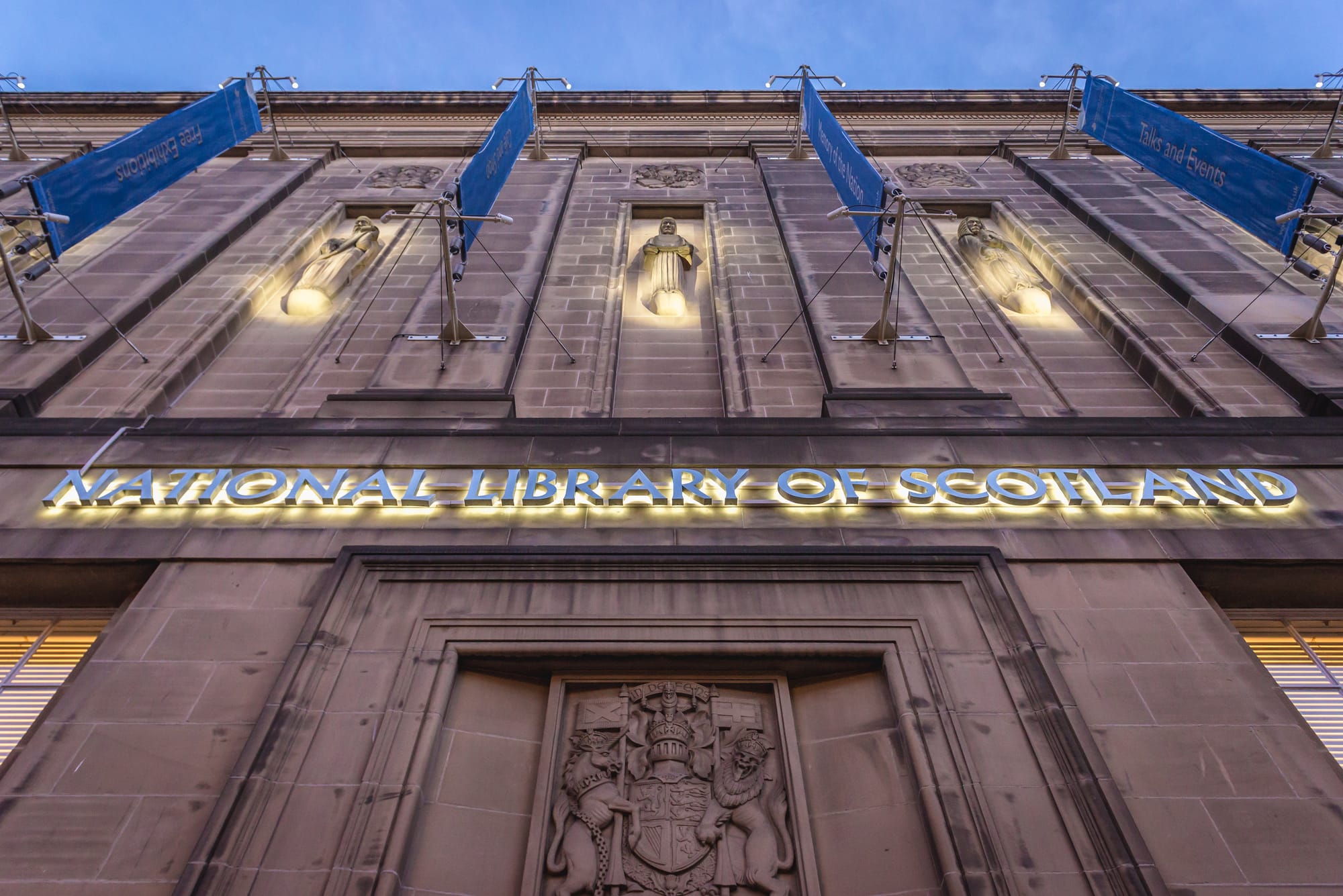
National Library of Scotland The copyright library for Scotland—if it was published in the UK, they likely have it. Strong collections in Scottish history, maps, and manuscripts. Reading room access requires registration (free, bring ID). The maps collection is exceptional for historical research.
George IV Bridge, Old Town. Closed Sundays.
Edinburgh Central Library More accessible than the National Library for casual research. The Edinburgh Room on the top floor holds local history collections, photographs, and city records.
George IV Bridge, Old Town.
National Records of Scotland Birth, death, marriage records. Wills. Court records. Essential for genealogical research or historical fiction requiring specific documentation. Appointments recommended for original documents.
General Register House, Princes Street.
The Writers' Museum A small museum dedicated to Burns, Scott, and Stevenson, housed in a 17th-century building. The museum itself is modest, but the building—Lady Stair's Close—is worth visiting for its architecture.
Off the Royal Mile.
University of Edinburgh Library The Centre for Research Collections holds manuscripts, rare books, and archives. Access requires advance arrangement for non-university researchers, but the collections are significant for Scottish literary and historical research.
Literary Geography
Edinburgh's literary history isn't just about famous writers. It's about how the city shaped writing—and continues to.
The Scott Monument — More interesting as a phenomenon than a destination. Why did Edinburgh build the world's largest monument to a writer? What does that say about how the city understood itself in the 19th century?
The Oxford Bar — Ian Rankin's Rebus drinks here. It looks exactly like you'd expect. Worth a visit not for the literary connection but because it's one of the few city-center pubs that hasn't been renovated into sameness.
Calton Hill — The view is famous, but the unfinished National Monument is more interesting. A failed attempt to build a replica of the Parthenon. What does it mean that Edinburgh's skyline includes a monument to ambition that ran out of money?
Greyfriars Kirkyard — Yes, the Bobby statue is there. Ignore it. The kirkyard itself is worth hours—the Covenanter prison, the elaborate monuments, the names that J.K. Rowling borrowed. Visit on a weekday morning when it's empty.
Arthur's Seat — The volcano in the city center. You can climb it in under an hour from Holyrood. The view matters less than the experience of having genuine wilderness inside a capital city.
Beyond the Center
Cramond — A village at the city's edge where the River Almond meets the Firth of Forth. Roman remains, a tidal island you can walk to at low tide, and a sense of how Edinburgh connects to the water and the land beyond.
Rosslyn Chapel — Thirty minutes south by bus. Famous now for Da Vinci Code tourism, but the chapel predates the hype by five centuries. The stonework is genuinely extraordinary. Go early on a weekday.
South Queensferry — Under the Forth Bridge. A small town overwhelmed by engineering. Useful for understanding scale—how Victorian infrastructure changed what was possible.
Portobello — Edinburgh's beach. Victorian resort architecture, a promenade, and a different relationship to leisure than the city center. Good for contemporary research.
Bookshops Worth Your Time
Topping & Company — A beautiful shop on Blenheim Place with knowledgeable staff and strong Scottish sections.
Golden Hare Books — An independent in Stockbridge with thoughtful curation and regular events.
Armchair Books — West Port, for chaotic secondhand browsing. You'll find things you weren't looking for.
Practical Notes
Weather — Edinburgh's weather is not optional atmosphere. It's constant and changeable. Layers, waterproof outer layer, shoes that can handle wet cobblestones. This isn't pessimism; it's research preparation.
Walking — The city rewards walking but punishes wrong shoes. The Old Town is steep. The New Town is long. Comfortable footwear matters more than style.
Festivals — August brings the Edinburgh International Festival, Fringe, Book Festival, and several others. The city transforms—more crowded, more expensive, but also more alive. Useful if your research involves performance, crowds, or cultural tourism. Avoid if you need quiet access to archives or residential neighborhoods.
Sundays — Scotland observes Sunday differently than England. Some attractions close or open late. Public transport runs reduced schedules. Plan accordingly.
Buses — Lothian Buses run frequently and cover the whole city. Exact change required unless you buy a day pass. More practical than taxis for getting a feel for how people actually move through the city.
The Research Advantage
Edinburgh gives writers something rare: a city that hasn't smoothed over its contradictions.
The Old Town and New Town still feel like different places. Wealth and poverty remain visible in the architecture. History hasn't been tidied into museums—it's still present in street names, building heights, and the way neighborhoods meet.
For writers, this means material is everywhere. Not just in the obvious places, but in the tensions the city hasn't resolved.
The question isn't what to see. It's what to notice.
Planning Your Research Trip
If you're working on a project set in or inspired by Edinburgh, Early & Away can help design a research itinerary around your specific needs—whether that's archive access, neighborhood immersion, or understanding how the city's geography shapes its stories.
Schedule a consultation to discuss your project.
Related: A Writer's Guide to North Yorkshire, England — another destination guide based on lived experience.